

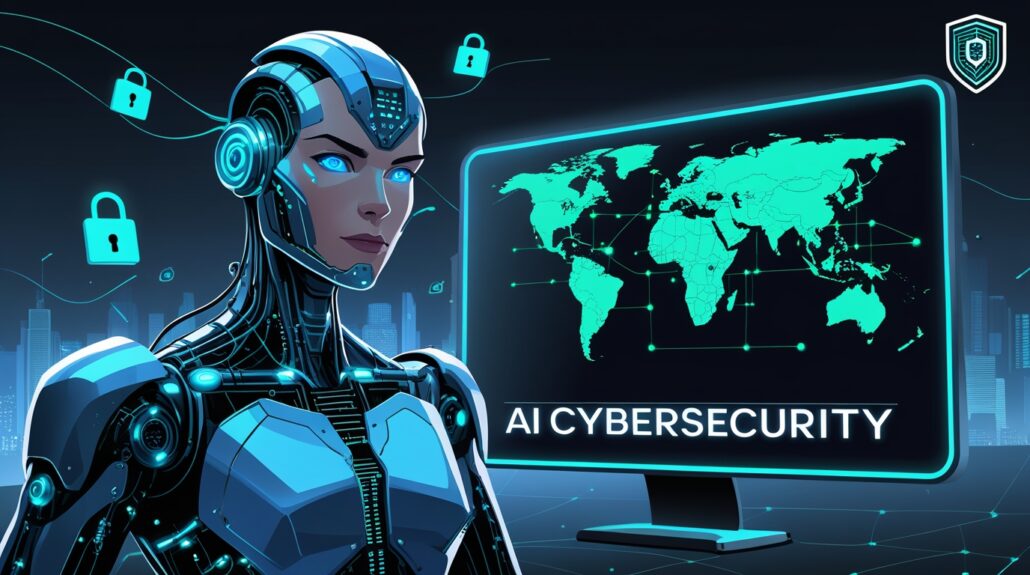
In today’s hyperconnected world, cyber threats are evolving faster than ever. Traditional security systems—built on static rules and manual monitoring—can no longer keep up with the speed, scale, and complexity of modern attacks. This is where AI cybersecurity steps in. By combining artificial intelligence with advanced security frameworks, organizations can detect threats earlier, respond faster, and protect digital assets more effectively than ever before.
What Is AI Cybersecurity?
AI cybersecurity refers to the use of machine learning, deep learning, and data analytics to protect networks, systems, and data from cyber threats. Instead of relying only on predefined rules, AI systems learn from massive volumes of data to identify patterns, anomalies, and suspicious behaviors in real time. This allows security platforms to recognize both known and unknown threats, including zero-day attacks.
How AI Is Transforming Cybersecurity
1. Real-Time Threat Detection
AI systems analyze millions of events per second—from login attempts to network traffic patterns. By learning what “normal” behavior looks like, AI can instantly detect anomalies that signal potential attacks, such as unusual access times, abnormal data transfers, or suspicious user behavior.
2. Automated Incident Response
Speed is critical in cybersecurity. AI-powered tools can automatically isolate infected systems, block malicious IPs, and trigger security protocols without waiting for human intervention. This reduces response time from hours (or days) to seconds.
3. Predictive Security
AI doesn’t just react—it predicts. By analyzing historical attack data, AI models can forecast potential vulnerabilities and attack vectors, helping organizations fix weaknesses before they are exploited.
4. Fraud and Phishing Prevention
AI excels at detecting subtle patterns in phishing emails, fake websites, and financial fraud attempts. This makes it especially powerful in protecting users from social engineering attacks that bypass traditional filters.
Benefits of AI Cybersecurity
- Scalability: AI can monitor vast networks and cloud environments effortlessly.
- Accuracy: Fewer false positives compared to traditional systems.
- Speed: Instant detection and response to threats.
- Adaptability: Continuous learning from new data and attack methods.
Challenges to Consider
Despite its advantages, AI cybersecurity is not without challenges. AI systems depend on high-quality data—poor data can lead to poor decisions. There’s also the risk of AI-powered cyberattacks, where hackers use AI to automate and scale their attacks. This creates an ongoing “AI vs AI” arms race in cybersecurity.
The Future of AI Cybersecurity
The future of cybersecurity is undeniably AI-driven. Governments, enterprises, and tech companies are investing heavily in AI-based security platforms. Organizations like IBM, Microsoft, and OpenAI are already developing advanced AI security solutions, while standards bodies such as NIST are shaping future frameworks for AI-driven security.
As digital transformation accelerates, AI cybersecurity will become not just an advantage—but a necessity. Businesses that adopt AI-powered security today will be far better prepared for the cyber threats of tomorrow.
Conclusion:
AI cybersecurity is redefining how we protect the digital world. By enabling smarter detection, faster response, and predictive defense, AI is becoming the backbone of modern digital security. In an era of constant cyber risk, AI isn’t just securing systems—it’s securing the future.
Related posts:
 CapCut Group Buy- All in one video editor & graphic design tool driven
 How to Use Slidesgo: A Step-by-Step Guide to Creating Stunning Presentations
 How to Convert FLAC to MP3 Group Buy Seo Tools
 Canva vs Design Pickle: Which is Better for Your Design Needs?
 Picsart vs Canva: The Ultimate Design Tool Showdown
 How to Use YouCam Perfect: A Beginner’s Guide to Flawless Photos
 AI Overviews with Semrush
 Hailuo ai video generator how to use prompt? Group Buy SEO